Alan & Sandra’s Incredible Cross Country Adventure
Mexico City + Tepoztlán + Cuernavaca
Puerto Escondido + Oaxaca
We began our adventure to Mexico’s central highlands region by flying into Mexico City (CDMX) then continued overland to the nearby cities of Tepoztlán and Cuernavaca before returning to CDMX to catch a plane to the beach town of Puerto Escondido. After splashing around in the water for a couple of days, we continued overland to Oaxaca where we stayed until it was time to fly back to Madison. The focus of this trip was to look for a place to settle down. For years I have been asking Sandra if she would like to move to another country and she always said no. The day after Trump was elected, I asked her again, and for the first time she said maybe, then the following day she said yes.
Sandra speaks Spanish as her first language, and I have a rudimentary grasp of the language. So, we decided that our best option would be to choose one of the 21 Spanish speaking countries. We then narrowed our search to Mexico and Spain. There are an estimated 1.6MM Americans (800,000 retirees) living in Mexico. While Spain is home to 41,000 Americans and 300,000 Brits. It was a difficult choice determining which country would best fit our needs. They both excel in different ways. After exploring both countries, we settled on Mexico. A short comparison of these countries is given at the end of this blog.
The next step was selecting which city to live in. We concentrated our search on the country’s central upper highland region. Though most expats choose to settle along Mexico’s coastal regions, we prefer the mountains more than the sea and found the coast to be way too hot for our tastes. We then narrowed our search to Tepoztlán (population 14,000 – 300 expats), and Oaxaca (population 711,000 – 20,000 expats). We had a very difficult time determining which city would best fit our needs. We love them both. Finally, we settled on Tepoztlán. Though Tepoztlán is very cosmopolitan for a city of its size, it is still a small town offering limited shopping, cultural and culinary options. Sandra is very much a big city girl and would only consider living in a place like Tepoztlán if she had easy access to a big city. CDMX is only a short 1.5-hour bus ride away.
Our quest for a place to live is far from over. We are aware that after spending more time in Mexico, we might have a totally different opinion of the place. We have heard that many Americans initially fall in love with Mexico but eventually move back to the States. There are many aspects to life in Mexico that would drive the average American crazy. Only time will tell if this would be the right move for us. We plan on slowly transitioning into this new life, at first spending time in both countries. After that, who knows.
Mexico City (CDMX)
Overview – This was our second trip to CDMX. If you want more information on this amazing city, visit our Mexico - Summer of 2025 page.
Chapultepec Park (Bosque de Chapultepec) – This is the place where the locals go to escape city life and immerse themselves in nature. Covering 2,140 acres (866 hectares), Chapultepec is 2.5 times larger than New York’s Central Park. It is home to nine museums, three artificial lakes, numerous sport facilities, and a castle.


Heading 6


Dance of the Flyers (Danza de los Voladores de Papantla) – This dance is part of an ancient Totonac ceremony for rain and fertility from the Veracruz region dating back to the 600s. The ritual represents respect for nature and connection to the divine. It is now performed in many public spaces across Mexico, including CDMX’s Chapultepec Park. The ceremony consists of four dancers representing the four four cardinal orientations who launch themselves backward off a platform 130 feet (40 meters) above the ground. A fifth person playing a flute and drum sits at the top of the pole as a representation of the center of the sun. The dancers spiral gradually down to earth like falling rain. Each dancer spinning 13 times, totaling 52 spins, symbolizing the number of years in the Totonac calendar cycle.


University City (Ciudad Universitaria) – University City is home to the UNAM, the most prestigious college in Mexico. The campus is famous for its stunning murals and modernist architecture that incorporate deep-rooted Mexican cultural and historical elements. The main sights on the campus are the MUAC art museum, the Central Library which is covered in mosaic murals by Juan O'Gorman depicting Mexican history, the Rectory Tower with murals by David Alfaro Siqueiros, and the Olympic Stadium famous for its Diego Rivera mural.


Heading 6


Basilica de Santa Maria de Guadalupe – With over 20 million visitors a year, this basilica is the most visited Catholic shrine in the world. People are attracted to the site because it is believed to be a place of miracles. It all started in 1531 when the Virgin Mary allegedly appeared before an indigenous convert and emblazoned her image on his cloak. In the 1700s a four-towered basilica was erected over the site. A new basilica was built next door in the 1970s to accommodate the ever-increasing throngs of followers. The new basilica, which holds 10 to 30 masses a day, can accommodate over 40,000 worshipers. The site also has a museum where you can see the Popemobile, a park with sculptures and waterfalls, and numerous small chapels.

Heading 6


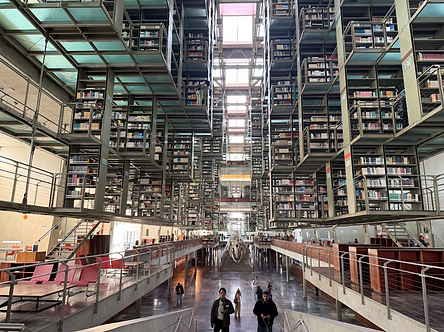
Vasconcelos Library – This library is one of the most photographed public buildings in the city. It is famous for its endless hanging steel shelves that seem to stretch back into a mirrored eternity. And it was allegedly the inspiration for the tesseract scene in the film Interstellar.

Cineteca Nacional – From classic retrospectives to contemporary indie movies, this theater complex offers a diverse range of screenings that appeal to all types of viewers. Cineteca is also a great place to hang out to have a drink or a bite to eat. All of their English and foreign language movies are not dubbed and are shown in their original language with Spanish subtitles which is uncommon in Mexico. We watched an English language movie that had its last few minutes in a foreign language. The Mexicans removed the English subtitles and replaced them with Spanish, leaving me totally in the dark. There are three Cinetecas scattered around the city.


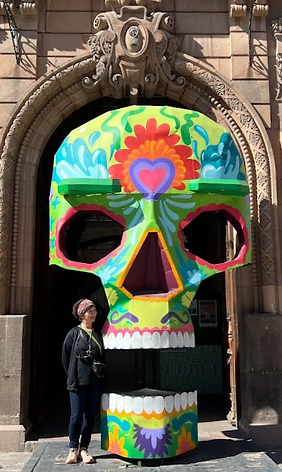
Mexico’s Obsession with Skulls and Skeletons – Skulls and skeletons are prominently displayed in sculptures, murals, and t-shirts throughout Mexico. These figures are frequently decorated with flowers to symbolize that life is present within death and are not considered to be morbid. Instead of fearing death, Mexican culture embraces it, often depicting these skeletons in common daily activities such as riding a bicycle, dancing, or taking a shower.


Heading 6


Heading 6


More Murals – We are totally fascinated by the vast variety of Mexico’s street murals and never get tired of this art form. It makes all of our walks in new locations an adventure of discovery.


Heading 6


Flowering Trees – Mexico’s upper highland region is home to a variety of vibrant flowering tree species that bud during the winter and early spring months painting the landscape in a mosaic of colors and aromas. The trees that were most visible during our visit were the Jacarandas that create purple flowers from February to April, the Colorínes that grow red flowers from January to March, and the Rosa Moradas that have pink-lavender flowers from January to March. Although not a tree, bougainvillea bloom year-round in spectacular shades that range from white to magenta. .


Tepoztlán
Overview – Tepoztlán, with its stunning landscapes, vibrant cultural scene, relaxing spas, and cobblestone streets lined with colorful houses, attracts hordes of nature lovers, spiritualists, and wealthy CDMXers enjoying their weekend homes. Of all the cities we visited in the USA, Spain, and Mexico in our search of a city to call our new home, Tepoztlán is the one place that comes the closest to checking all of our boxes. This was our second trip to Tepoztlán. If you want more information on this enchanting city, visit our Mexico - Summer of 2025 page.
Demographics – The town has a population of 14,000, while the town plus surrounding villages has a total population of 55,000. The local expat community which is believed to be in the hundreds appears to be primarily American.
Elevation – Tepoztlán has an average elevation of 5,600 feet (1,700 meters).
Getting There – Depending on the time of day, there is an express bus leaving CDMXs Southern Terminal for Tepoztlán every 20 to 60 minutes. Travel time is only 1.5 hours. Express buses also travel between Cuernavaca and Tepoztlán every 30 minutes. This trip is only around 40 minutes.
Getting Around – One can easily live in Tepoztlán without a car. There is an extensive network of combis routes servicing most of the city and surrounding villages. Combis are vans, with bench seating installed along the four sides of the interior. The benches were not as comfortable as bus seats, but most of our rides were under ten minutes, so it was not much of an issue. The combis we traveled in were fairly new, clean and had automatic opening and closing doors. Combis follow set routes but there are no maps showing where these routes go. Proper combi etiquette when boarding is to greet everyone with a “Good morning/evening”, and for all of the other passengers to respond back. For the areas not served by combis, taxis are inexpensive and abundant.

Mountains – Tepoztlán is a popular location for outdoor enthusiasts. The city lies in a gentle valley sandwiched between two mountain ranges that climb rapidly from the city’s outskirts. The range to the north is the most impressive of the two with its tallest peak reaching 7,579 feet (2,310 meters), while the southern range reaches a height of 6,756 feet (2,060 meters). According to alltrails.com, there are nearly 20 mountain trails starting at the edge of the city. Besides hiking in the mountains, other popular outdoor activities are caving, horseback riding, 4X4, and mountain bike excursions. Being that Tepoztlán is home to two mountain ranges it seems that almost every street in the town has a mountain view.


Heading 6


Heading 6


Spiritualism – Due to its intense geological energy and indigenous mystical history, spiritualists and wellness enthusiasts believe that Tepoztlán lies within a healing vortex. The area is believed to be the birthplace of the Aztec God Quetzalcóatl. Thousands of tourists visit the city every year to attend energy healing classes, yoga/meditation retreats, and pre-Hispanic (Temazcal) sweat lodge rituals for detoxification and spiritual purification.
Health Care – There is no hospital in Tepoztlán. But the city does have two clinics that can manage most medical ailments, with one being a 24/7 urgent care clinic. For serious emergencies or specialized care, one would need to travel around 30 minutes to a hospital in Cuernavaca. Ambulances are always on standby. Tepoztlán also has a strong reputation for holistic alternative medicine.
Safety – Tepoztlán is a very safe city. Crime rates here are low compared to the rest of Mexico. While petty crimes such as pickpocketing do happen, they are not frequent and violent crimes are very rare.
Public Market – In 2024 the city constructed a new very modern, but somewhat sterile looking public market building. The building was built on a steep hillside, offering a ground level entrance on one side and the best views of city on the other. In addition to the main public market, there is a smaller daily outdoor market next to the plaza and two Friday organic markets.

Heading 6


Shopping – Shopping options for things other than basic food staples are limited in Tepoztlán. To make up for this, many locals do weekly shopping trips to Cuernavaca where you can find a Home Depot, Best Buy, Costco, Walmart, and several first-rate supermarkets.
Eating Out – Tepoztlán offers a surprising variety of culinary options for a Mexican city of its size. Besides some great Mexican restaurants, this city is home to five Asian, three Argentinean, and two Middle Eastern restaurants. The city also has a number of bakeries and cafes offering yummy baked goods with a good selection of them being gluten free. As you can imagine, some of the restaurants have awesome mountain views. The picture on the left was taken on our previous trip during the rainy season. The one on the right was during the dry season. Quite a different look.


Ice Cream – The ice cream shop chain, Tepoznieves, is popular throughout the region for serving over 100 unique flavors of nieves. Known for their artisanal preparation and intense fruit flavors, nieves are for the most part light water-based treats that is something between a sorbet and an ice cream. Tepoznieves' flag ship location is filled with numerous displays of skeleton sculptures and resembles more an art museum than an ice cream shop.


Carnaval & Chinelos – In the days leading up to Ash Wednesday, over 200 communities around Mexico host carnaval celebrations, each with their own unique spin on the festival. The four-day Tepoztlán Carnaval is one of the most popular in the Morelos region. For the first two days the streets of the Centro district were filled with partying out-of-towners. The last two days the festival had a different feeling with the plaza and neighboring streets filled with music and chinelos doing traditional Brinco dances. Chinelos, unique to this region, originated in the 1800s as a form of social resistance by local indigenous and mestizo who dressed up in elaborate costumes and masks that satirized and mocked their Spanish colonizers. The Tepoztlán version of the chinelos includes a black velvet robe often covered on the back with hand-painted images, a wire mesh mask of exaggerated European features, and a tall, funnel-shaped hat adorned with sequins and ostrich feathers.


Heading 6


Heading 6


Heading 6


Dilao Sculpture Park – The park, owned and operated by Philippines sculptor Eduardo Olbes, features a collection of contemporary sculptures created by him and other artists in a beautiful outdoor setting highlighting the relationship between nature and art. On site is a restaurant serving Mexican and Filipino dishes.


Amatlán de Quetzalcóatl & Pinturas Rupestres Trail – Amatlán (population 1,000), a half hour drive east of Tepoztlán, is home to a large portion of the local expat community. We visited the village to see if we would consider living there but felt that it was too isolated for us. During our visit we hiked the Amatlán Pinturas Rupestres Trail (1.4 miles – 530 feet elevation gain) that is known for its cave paintings and rock formation "La Puerta" (The Door). We found the trail to the cave paintings to be too difficult but did make it to La Puerta, which is a 49 feet high (15 meter) cavern created from two massive boulders resting against each other. This cavern is believed to be the birthplace of the god Quetzalcóatl, so it has great spiritual significance for the local indigenous population who place offerings there. We saw a few fresh offerings on the day of our visit.


Heading 6


Cuernavaca
Overview – A principal attraction of this colonial city has always been its year-round temperate climate. Before the era of air travel, the “City of Eternal Spring” had a history of being the place to be seen for the high society of CDMX seeking escape from the hustle and bustle of big city. Today the wealthy have moved on, so you are now more likely to see Spanish language students. Cuernavaca is home to over fifty Spanish language schools. Unfortunately, most of the elegant mansions of Cuernavaca’s colonial era are hidden away from view behind tall walls except for the ones converted into fine hotels, spas and museums, such as the Robert Brady estate (see below).
Demographics – Cuernavaca has a metro population of 1,029,000, which includes over a thousand expats.
Elevation – 5,000 feet (1,500 meters)
Getting There – There are numerous express buses a day going to Cuernavaca, leaving from CDMX’s southern bus terminal and from the MEX airport. Travel times are 1.5 to two hours.

Heading 6


Heading 6


Heading 6


Borda Garden (Jardín Borda) – This beautiful formally laid out garden in the center of the bustling city was constructed with a series of terraces, fountains, and an artificial pond. The gardens were constructed in the 1780s by the sliver magnate Manuel de la Borda as an addition to his stately home. In the 1860s, Emperor Maximilian and Empress Carlota made the property their summerhouse and held lavish parties in its gardens. In the 1980s the gardens were restored and opened to the public.


Teopanzolco Archaeological Zone – The city of Teopanzolco was built in the 1300s by the Tlahuica people. In 1427 the city was conquered and integrated into the Aztec Empire. All that remains today of this great city is its ceremonial center. The rest of Teopanzolco is completely covered by the modern city of Cuernavaca.

Robert Brady Museum – This beautiful estate was originally constructed in the 1500s as a Franciscan monastery. The monastery, now know as Casa de la Torre, was abandoned for many years until Robert Brady purchased it in 1960 and restored it to its present-day glory. Robert Brady was an independently wealthy American artist who spent his life traveling around the world collecting art and ethnographic artifacts for his collection. All the rooms, including the bathrooms and kitchen, are covered in paintings, carvings, textiles, antiques and folk art.


Heading 6


Heading 6


Puerto Escondido
Overview – Puerto Escondido a small mellow, but rapidly growing town, where Mexicans and world travelers intermingle in beachside bars and surf shops. Some predict that this sleepy town could become the next Cancun. The area consists of seven main beaches, ranging from long wide stretches of sand to small intimate coves. Popular activities here are surfing, snorkeling, deep-sea fishing, releasing baby turtles, whale watching, and at night sitting in a beachside bar listening to live (mostly English) music. Sandra and I are not sun worshipers, and though we thoroughly enjoyed our stay, after three days of constant sun, we were ready to leave. We found the first three hours after sunrise and the last hour before sunset to be very enjoyable. The rest of the day we would hide in the shade and avoid the sun except for short dips in the water.
Demographics – Puerto Escondido has a population of 45,000, which includes a very large expat community. This is the first Mexican town we visited where it appears that the Canadians outnumber the Americans.
Getting There – There are a couple of 3.5-hour express buses a day from Oaxaca. It used to take eight hours to make this trip, but the government recently cut a highway through the mountain range connecting the two cities. This new road reaches heights of 8,200 feet (2,500 meters) before descending down to the coast. Unfortunately, the road is sometimes closed during the rainy season due to avalanches. There are direct flights to Puerto Escondido from Dallas, Houston, Los Angeles, Toronto, and Calgary.
Playa Zicatela – Because of undertows, this 2.2 mile long (3.5 kilometer) beach is not safe for swimming but is great for long walks and professional surfing. Zicatela is considered to be one of the best beaches in Mexico for surfing, and is home to international competitions. At the north end of the beach is the city center and at the south end is the Punta Zicatela neighborhood. La Punta, where most of the expats live, is a laid-back, bohemian surf town with sandy streets and vibrant nightlife. Here you will find bars, restaurants, cafes and yoga studios catering more to gringo tastes.
Heading 6


Heading 6


Heading 6


Playa Carrizalillo – Nestled in a secluded cove at the bottom of a 170-step stairway and a short walk from town, sits the beautiful but small Carrizalillo beach. With its turquoise water, tall cliffs, and rows of palm trees coming within a few meters of the waterline, Carrizalillo is the type of beach we love the most. Carrizalillo is a great beach for swimming or taking beginning surfing classes. For shade you can rent a lounger for $14 a day from a beachside restaurant.


Heading 6
Heading 6


Playa Manzanillo and Puerto Angelito – Also a short walk from town, these two beaches are located within the same bay and are connected by a walkway through a rock field. Manzanillo was our favorite beach in the area. We considered it to be more picturesque and relaxing than all of the beaches we explored. Both beaches are lined with seafood restaurants providing free all-day loungers in the shade with the purchase of $14 worth of food or drinks.


Heading 6


Heading 6


Playa Bacocho & Turtle Release – A short taxi ride from town is Bacocho Beach, a long wide stretch of sand with a strong undercurrent and no shade in sight. The only reason we visited this beach was to participate in the Vive Marbaby turtle release and afterwards watch a free movie on the beach at Club Bacocho. Both were a short walk from the taxi drop off. The turtle releases are conducted daily from 5:00 to 7:00 pm. And the free movies are held every Wednesday from December to March at 7:30.
Four of the world’s seven sea turtle species lay their eggs on the beaches of Oaxaca, and they are all in danger of becoming extinct. ViveMar is working diligently to reverse this trend. After registering, we received a lecture on the local turtle species and ViveMar’s conservation efforts. We were then lined up along the shoreline, and I was given a dried fruit gourd and Oscar, my hatchling. I was instructed not to touch Oscar and to only release him/her when told to do so. Hovering overhead was a flock of seagulls waiting for their dinner. After the turtles were released, the volunteers started throwing handfuls of sand at the diving seagulls. This averted most, but not all of the birds. The turtles know by instinct to move towards the ocean. This memory will be imprinted so they know which beach to return to for laying their eggs. Unfortunately, some of the turtles just sat there or, like Oscar, started walking away from the water. Eventually, a volunteer came around to scoop up all of the stragglers and transplanted them closer to the ocean. I can only hope that Oscar made it to the safety of the water.


Heading 6


Oaxaca
Overview – We love Oaxaca. That is why it came in a close second in our search for the best city for us to live in. This was our second trip to Oaxaca to check it out. If you want more information on this enchanting city, visit our Mexico - Summer of 2025 page.


Heading 6


Heading 6


Calendas – Calendas are community parades with music and dance celebrating special events such as weddings and graduations. We saw one or more calenda winding through the historical district almost every day. Originating during the colonial period as religious processions, over time the calendas took on more of an indigenous energy creating something uniquely Oaxacan. In a calenda there is no separation between the performers and the crowd. Onlookers are encouraged to join in to share in the joy of the celebration. A typical calenda would start out with the Marmota Carrier which spins a large sphere displaying the name of the honorees followed by a brass band and Mojigangas (10 to 18 feet tall papier-mache puppets). Mixed in are dancing Chinas Oaxaqueñas (women with floral baskets on their heads) and Tiliches (see below).


Heading 6

Heading 6


Tiliches – Tiliches, which are unique to the Oaxaca region, are often seen at Carnaval and other special events dancing vigorously shaking their costumes. Their outfits are compiled from countless strips of colorful tattered rags, animal skin masks, and oversized hats made from woven palm fibers. Tiliches represent the elderly peasants who once labored in the fields, honoring their work and their indigenous roots.


Auditorio Guelaguetza & Escarpada Trail – The Guelaguetza Auditorium sits on a mountain ridge and can be seen from almost anywhere in the city. This auditorium, which is considered to be one of Mexico’s best venues for the performing arts, is an open-air structure that can seat over 11,000. The construction of this building’s roofing is unique, featuring six large membrane pieces tied together. The auditorium can be reached by car or by hiking up the 100 plus stairs that lead from the city. Behind the auditorium going higher up in the mountain is a maze of trails extremely popular in the early morning hours for hikers, joggers, and mountain bikers, as the area is considered to be unsafe later in the day. The loop trail we took was 3.3 miles long with an elevation gain of 820 feet.


Heading 6


Day of the Good Samaritan – This is a cherished Oaxacan tradition celebrated during the morning of the fourth Friday of Lent. Throughout the city, restaurants, public buildings, and churches set up stalls decorated with bougainvillea and palm leaves and give away free glasses of aguas frescas (fruit-flavored waters). It is all based on the biblical story of a Samaritan woman offering water to Jesus. In the city’s main plaza, they went a step farther and handed out free pastries and ice cream cones.


Heading 6


Oaxaca Lending Library & Guacamaya Hike – The Oaxaca Lending Library, is the community center for the Oaxaca expat community. Besides being a place to check out books, the library is a hub for 1) charitable outreach programs; 2) various special interest clubs; 3) Saturday morning intercambios which are language exchanges between Spanish and English speakers improving each other’s language skills: and 4) group hikes into the nearby mountains. We participated in several intercambios and one hike. Our hiking day began when we were picked up at the meeting point in a van and driven an hour to the village of La Guacamaya (8,900 feet elevation). There we met our guides and began our hike to two lookouts, and a waterfall. The library hikes are inexpensive and well organized.


Heading 6


Heading 6

Oaxaca’s Main Plaza (Zócalo de la Ciudad de Oaxaca) – Every city we visited in Mexico had a Zócalo. In my opinion Oaxaca’s was the best we have seen to date. The Zócalo is a popular pleasant spot to relax. Every time we visited, the area was filled with people enjoying themselves. We spent many hours just sitting at a table in one of the many cafes circling the plaza watching the people go by and musicians performe. The only drawback to this experience was that we were constantly being approached by street vendors pitching their wares.


Heading 6


Civil Disobedience – Civil disobedience is a deeply rooted tradition and a constant way of life in Oaxaca. While most protests are peaceful, some escalate into massive uprisings. The most recent uprisings were in 2006 and 2016. We saw several marches and rallies during our visit. The largest were on International Women's Day. That day there were two massive groups converging on the center of the city. Both groups were mostly peaceful. However, mixed in within one of the protests was a large group of women covered head to toe in black with only their eyes showing. Some of these women acted very intimidating to the men they passed by. In anticipation of the protest, some local businesses boarded up their establishments. One of these barricades was set on fire, scorching the front of the building.


Black Pottery Village of San Bartolo Coyotepec – Oaxaca black pottery (barro negro) is a world-renowned craft that has been produced in this region for over 2,000 years. Today, this art form is preformed primarily in San Bartolo. This village is home to numerous black pottery studios and the very nice Museo Estatal de Arte Popular Oaxaca.. Black pottery is famous for its distinct rich black metallic shine. The deep black color is achieved when the pieces are fired at a high temperature in a kiln with limited oxygen causing carbon to permeate the clay. The shiny metallic effect is achieved by burnishing the clay with a quartz stone before firing. Surprisingly this effect is achieved without using any glazes. San Bartolo can be reached by taking a shared red taxi (colectivo) that follows a set route and charges a fixed fee.


Heading 6


Alebrije Sculpture Village of San Martín Tilcajete – Alebrijes are whimsical hand-carved wooden sculptures of imaginary creatures that are brightly painted in detailed Zapotec-inspired patterns. This art form only dates back to the 1930s. Though it is quite new compared to other traditional Mexican art forms, alebrijes have become an integral part of Oaxacan Mexican culture. San Martin is home to numerus alebrije studios, some of which provide tours in English. This village can be reached by taking the same colectivo going to San Bartolo and remain seated for an additional half-of-an-hour.

Heading 6


Which is Better, Mexico, Spain, or the USA
It was a difficult choice for us deciding between Mexico and Spain. In many ways, for many people, Spain would be the better choice. Yet, we felt that for us, Mexico was a better fit for our needs. Even though living in Mexico has many drawbacks to consider and adjust to, at this time, we fell that the pros outweigh the cons. Hopefully, after spending some time there, our feelings will not change. For someone sitting a home who might be thinking of moving abroad but don't know which country to choose, an excellent place to begin their journey is InterNations.
InterNations conducts an annual survey to determine the satisfaction levels of retirees and digital nomads living in 46 countries. These scores are based solely on perception. For example, under “Safety & Security”, the rating reflects how safe the foreigners felt in their host country and not on how safe they actually were. In 2025 over 10,000 expats responded ranking Mexico in third place, Spain in ninth-place place, and the USA in a distant 36th place. It is interesting seeing one’s country through the eyes of foreigners. I suspect that the USA rankings in 2026 will be even worse. If you are wondering, Panama and Colombia were considered the best countries to move to, while Turkey and Kuwait were the worst. To see the entire InterNations raking click here.
Healthcare – InterNations ranked Spain in first place and Mexico 19th. Surprisingly the USA came in dead last in 46th place, which is a reflection on our lack of universal coverage and high medical costs. Statistically, the average quality of healthcare in Spain and the USA are comparable, with Mexico lagging behind. However, if you look at the best healthcare available in each country for those that can afford it, Mexico ranks as good as the others.
Safety & Security – Statistically, when it comes to both violent and non-violent crime, Spain is by far the safest with Mexico being the least safest of the three countries. InterNations ranked Spain in 14th place, Mexico 33rd, and the USA 43rd. I found it very interesting that foreigners living in Mexico felt safer than foreigners living in the USA. The USA homicide rate is 5.9 per 100,000, while the rate of Americans killed in Mexico is only 2.1 per 100,000 Americans.
Ease of Settling In – This is an area where Mexico shines coming in first place with Spain ranked 13th and the USA 25th. This score was based on questions like “How welcoming are the locals to foreigners?” and “How easy is it to find friends?”.
Ease of Dealing with Bureaucracy – The InterNations survey ranked Mexico the best in 18th place, the USA close behind in 19th place, and Spain 26th. Presently, the Mexican government has a much more tolerant view of foreigners than the Spanish government does. It is far easier and cheaper for a foreigner to obtain residence and purchase property in Mexico than it is in Spain. For example, everyone purchasing property in Spain is required to pay a 10% tax. Last year this tax was increased to 20% for non-EU residents.
Housing Affordability – Mexico was ranked 8th, followed by Spain in 26th, and the USA in 29th place. Though, housing costs in cities with high expat populations can be nearly as expensive as in the USA.
Cost of Living – Mexico ranked 8th, Spain 11th, and the USA 35th. The cost of living in Spain is on average 33% cheaper than it is in the USA and Mexico is 43% cheaper.
Happiness – Of the three countries, based on various studies, it appears that Mexico has the happiest people, while the USA has the least happy. When it comes to the happiness levels of the expats in these countries, InterNations ranked Mexico 3rd, Spain 4th, and the USA a distant 34th.
Do you want to live in your host country for the rest of your life? – On average 24% of the InterNations respondents answered yes to this question. 39% and 41% of the foreigners in Mexico and Spain said yes, while only 17% of the expats in the USA wanted to stay long-term.
Public Transportation – With nearly 2,500 miles (4,000 kilometers) of high-speed rail, Spain has one of the best intra-city transit systems in the world. One can travel from Seville to Barcelona, over 700 miles (1,100 kilometers), in under six hours. In Mexico one can travel by bus to almost every city in the country. Certainly not the case in the USA. For example, Tepoztlán (population 14,000) offers far more intra-city bus options than Madison (population 270,000).
Civil Rights, Freedom of the Press, and Political Stability – It would appear Spain is the best country for these categories, and Mexico is the worst of the three countries.
Weather – On average the weather in Mexico’s central highlands region is far more temperate and pleasant than it is in Spain and most of the USA. Because of Tepoztlán high elevation, after the suns sets on hot days the temperature can drop as much as 25 degrees through the night. Another big plus is this area experiences seven months of almost no rain followed by five months of rain-free, and often sunny, mornings and early afternoons, making it very easy to plan your outdoor activities.
Architecture – Though we found the architecture in Spain’s historical districts to be amazing, we found Mexican cities as a whole to be more visually interesting with their rich blend of indigenous, Spanish colonial and modern architecture.
Sense of Community – Mexicans are known for their strong family ties and mutual support that prioritize the group over the individual. This extends to a community wide culture of mutual support that goes far beyond simple neighborly gestures.
Food – Though Spanish food is quite good, we prefer the vast variety of indigenous and European influenced dishes found in Mexico.
Mañana (Tomorrow) Culture – Spain’s and Mexico’s Mañana culture can be viewed as both a negative and a positive. Many expats find this way of life at times to be very frustrating with simple tasks taking much longer than expected. However. If one can go along with the flow, they could live a more relaxed and unhurried existence valuing more life's moments and connections.